

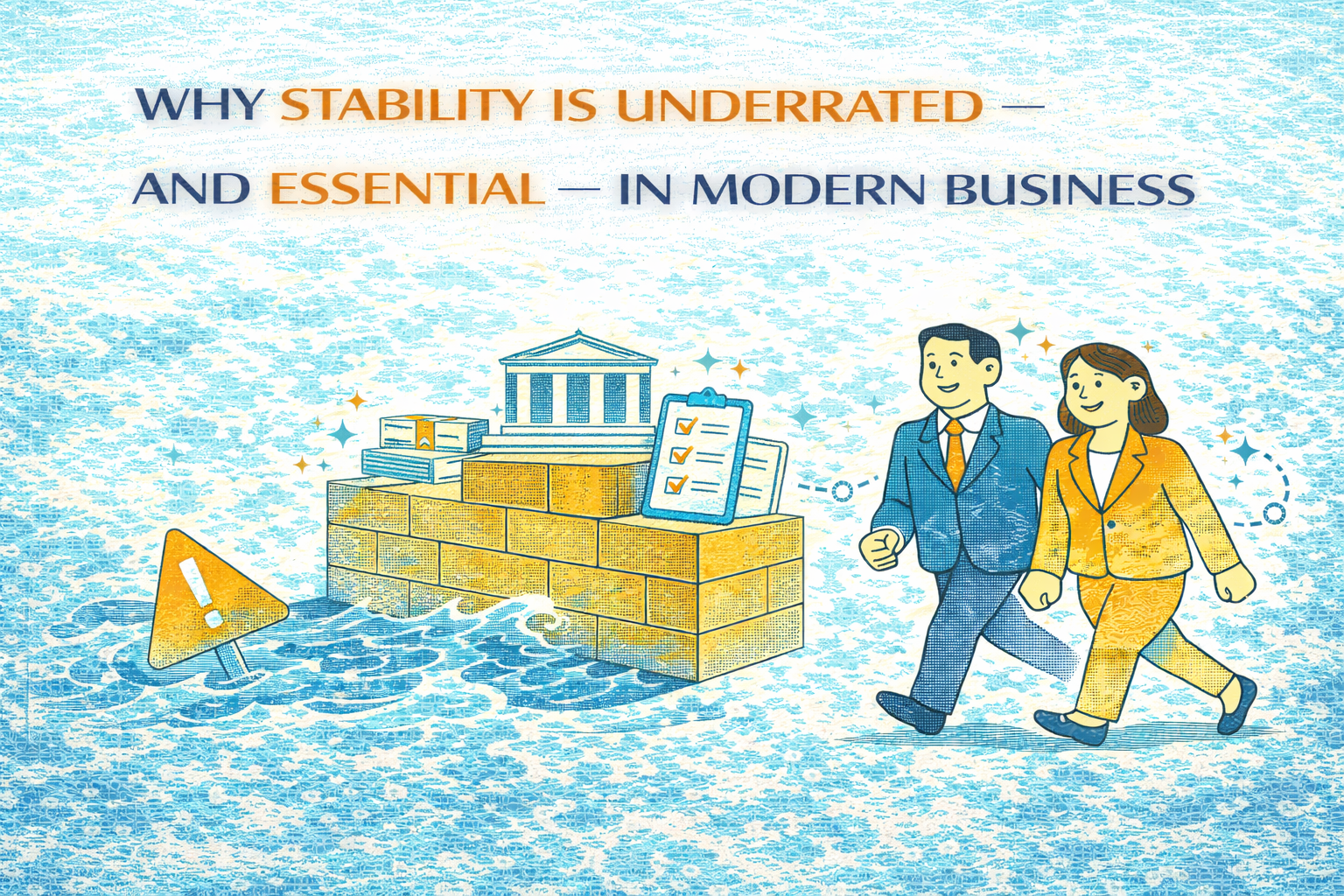
In modern business culture, stability rarely gets much credit.
Speed is celebrated.
Agility is praised.
Disruption is admired.
Stability, by contrast, is often associated with being slow, conservative, or resistant to change.
Yet when you look closely at businesses that endure—through market shifts, team changes, and economic cycles—a different picture emerges:
Stability isn’t the opposite of progress.
It’s what makes progress sustainable.
At ccMonet, we believe stability is one of the most underrated—and essential—qualities a modern business system can have.
Modern businesses operate in fast-moving environments. New tools, new regulations, and new expectations arrive constantly.
In response, many companies prioritize:
Stability can feel secondary—something to worry about later.
But when systems are designed only for speed, businesses often experience:
What looks like agility on the surface often hides fragility underneath.
One of the biggest misconceptions about stability is that it resists change.
In reality, stability enables change.
Stable systems:
Unstable systems force businesses to slow down because every change introduces risk.
Stability isn’t rigidity.
It’s resilience.
Today’s SMEs face more complexity than ever before:
In this environment, instability compounds quickly.
When systems are unstable:
Stability reduces this friction by creating a dependable baseline—so attention can be spent on strategy, not correction.
At ccMonet, stability isn’t treated as a byproduct of maturity.
It’s treated as a design objective from the start, especially in finance and compliance.
Long-term stability is built through ordinary days done well.
By focusing on correct, consistent daily financial processes, ccMonet helps prevent small issues from accumulating into major disruptions.
Businesses change. People move on.
ccMonet is designed so finance and compliance don’t rely on founder memory or individual heroics—but continue operating reliably through change.
When compliance is continuous, it doesn’t introduce instability during deadlines or transitions.
It becomes predictable, calm, and largely invisible.
When stability is built into systems, businesses experience subtle but powerful shifts:
Founders trust the numbers without hesitation.
Expansion doesn’t amplify uncertainty.
Less time is spent checking, explaining, or fixing.
Stability doesn’t slow modern businesses down.
It removes the drag that slows them quietly.
SMEs can reflect on a few grounding questions:
Inconsistency signals fragility.
Stable systems absorb change smoothly.
If confidence declines with scale, stability is missing.
Systems like ccMonet are built to strengthen stability over time—not trade it for short-term speed.
Agility without stability is fragile. Stable systems make agile decisions safer and faster.
Because early systems are often designed for speed and setup—not long-term consistency and growth.
No. Well-designed stable systems enable flexibility by providing a reliable foundation.
By building finance and compliance systems around daily consistency, continuous review, and independence from individual effort.
Learn more at https://www.ccmonet.ai/.
Modern businesses move fast—but only stable foundations allow them to move forward with confidence.
If your current systems feel responsive but fragile, it may be time to rethink what stability really contributes to growth.
👉 Discover how ccMonet helps SMEs build stable, reliable systems for the long run at https://www.ccmonet.ai/.

.png)
.png)


