

Dashboards are everywhere.
More charts.
More metrics.
More real-time views of everything that’s happening in the business.
For many SMEs, dashboards feel like progress. They promise visibility, control, and faster decisions.
But here’s the uncomfortable truth:
Most SMEs don’t have a visibility problem.
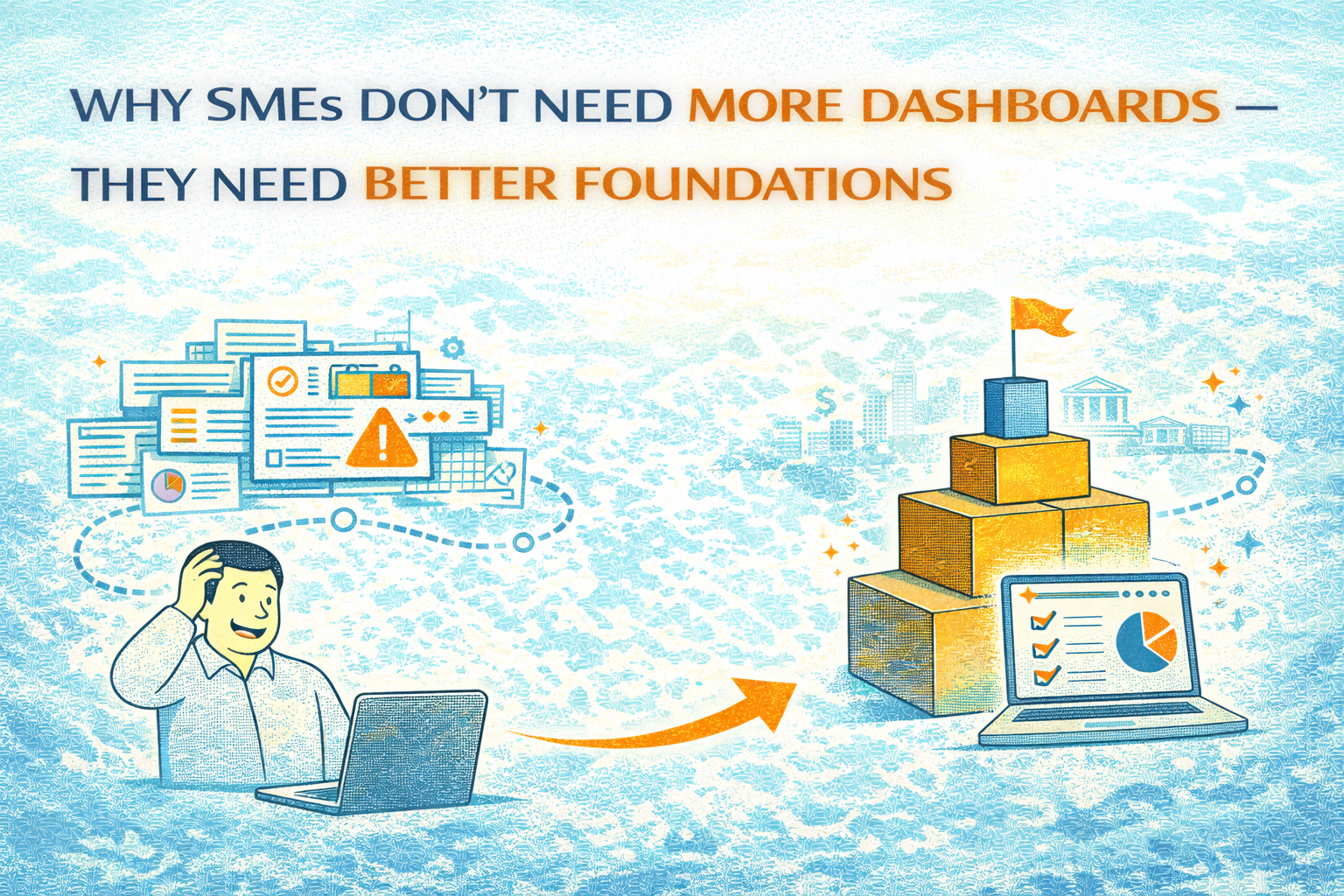
They have a foundation problem.
At ccMonet, we’ve learned that adding dashboards on top of weak systems doesn’t create clarity.
It often creates more noise.
Dashboards are designed to show information.
But they can’t fix how that information is produced.
In many growing businesses, dashboards sit on top of:
The result looks impressive—but feels unreliable.
Founders check the dashboard, then:
The dashboard didn’t fail.
It simply revealed that the foundation wasn’t solid.
Clarity isn’t about seeing everything.
It’s about trusting what matters.
For SMEs, clarity means:
Dashboards surface outcomes.
Foundations determine whether those outcomes can be trusted.
Without strong foundations, dashboards amplify uncertainty instead of reducing it.
When finance and compliance foundations are weak, symptoms show up everywhere:
This slows the business—not because information is missing, but because confidence is missing.
At that point, adding another dashboard doesn’t help.
It just adds another layer to manage.
At ccMonet, we believe dashboards should be the result of good systems—not the solution to broken ones.
That belief shapes how we think about SME finance and compliance.
When records are captured correctly, reviewed continuously, and maintained consistently, clarity emerges naturally.
You don’t need to “watch” the system when you trust it.
Real-time data isn’t useful if it’s not dependable.
ccMonet prioritizes correctness, review, and continuity—so when information is surfaced, it’s immediately usable.
Dashboards don’t reduce compliance risk.
Foundational systems do.
When compliance is continuous and built into daily processes, visibility becomes calm instead of stressful.
When SMEs invest in foundations instead of dashboards, behavior changes:
Founders stop hesitating because they trust the numbers behind the views.
Reliable systems reduce back-and-forth and clarification.
Expansion doesn’t amplify uncertainty—it builds on stable ground.
Foundations don’t look exciting.
But they compound quietly over time.
Before adding more visibility, SMEs can ask:
If not, visibility won’t help.
If they drift, the foundation is weak.
If yes, the system isn’t doing enough work.
Solutions like ccMonet are designed to strengthen foundations first—so visibility becomes a benefit, not a burden.
They can be—but only when built on reliable systems. Dashboards don’t create trust; foundations do.
Because they sit on fragmented, inconsistently reviewed data, forcing founders to compensate with attention.
No. Dashboards work best after foundations are strong—not as a substitute for them.
By combining intuitive workflows, AI-powered processing, and expert review, ccMonet helps SMEs maintain accurate, compliant, and dependable financial systems.
Learn more at https://www.ccmonet.ai/.
Dashboards can show you what’s happening.
Foundations determine whether you can act on it with confidence.
If your business keeps adding visibility but still feels uncertain, the problem may not be what you’re seeing—but what’s underneath.
👉 Discover how ccMonet helps SMEs build strong financial and compliance foundations at https://www.ccmonet.ai/.

.png)
.png)


